Game Overview – If/Then by Arcane Wonders

I loved games like Mastermind when I was growing up. There was something satisfying about looking at a little bit of information, making a guess and using the response to figure out what to try next. Even an incorrect answer could tell you something useful. Of course, it could also tell you that the theory you were feeling pretty confident about needed to go straight out the window!
That same kind of puzzle is at the heart of If/Then from Arcane Wonders. Before we go any further, I should mention that I designed this one. Rather than offer an outside review of my own game, let me show you how it works and what everyone will be trying to figure out around the table.
If/Then is a game of cooperative deduction and pattern recognition for two to six players, ages 10 and up. Arcane Wonders lists a playing time of ten to thirty minutes. One person becomes the All Knowing, who secretly reads the challenge for the game. Everyone else becomes a Code Breaker, working together to discover the hidden rule.
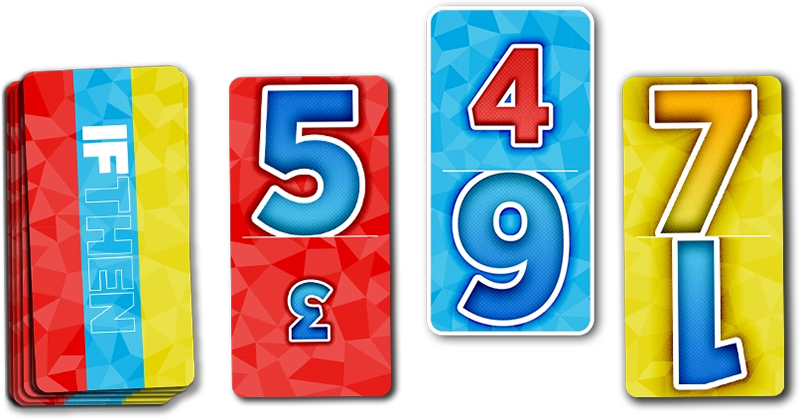
The Number Cards give you several things to consider. A number can have a different value, size or color, and the background has its own color, too. Both ends of each card can be used, and you can rotate a card to choose which end faces up. Only the upper portion counts when it enters the Code Line. That’s a lot of information tucked into one card!
For your first game, begin with the Level 0 challenges. The All Knowing reads one privately, removes the appropriate number of Number Cards from the deck and deals three to each Code Breaker. In a two-player game, the lone Code Breaker receives six. Three cards form a face-up market, and the All Knowing places a starting card in the Code Line.
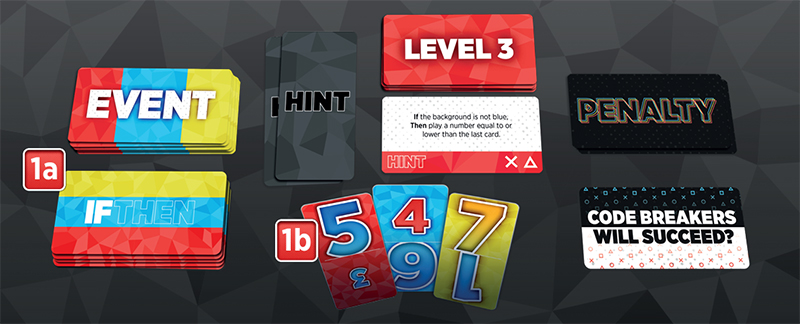
On your turn, choose a card from your hand and orient it the way you think will satisfy the challenge. Add it to the end of the line, overlapping the lower half of the last valid card. The All Knowing checks the rule and announces whether your placement is valid or invalid. A valid card extends the line, while an invalid one is placed beside it as a reminder.
Now everyone has another piece of evidence. Was the number’s value important? Its color? Maybe the background mattered instead. Imagine two accepted cards with the same background but different number colors. That gives you a possible explanation to test, although it doesn’t prove you’ve solved anything. One successful guess isn’t quite enough to declare yourself a genius.
The Code Breakers can freely discuss their theories, but they cannot discuss the specific cards in their hands. The All Knowing stays impartial and doesn’t join that discussion or offer advice. Being all-knowing does come with a few restrictions… Knowing the answer doesn’t give them permission to rescue everyone from a bad theory.
Playing into the line isn’t your only option. You can discard a card if you believe neither orientation would be valid. If you’re right, you’ve removed another card from your hand. If either orientation could have worked, the card returns to you and you take a penalty. It’s up to you to figure out which side would have been valid and use that information moving forward.
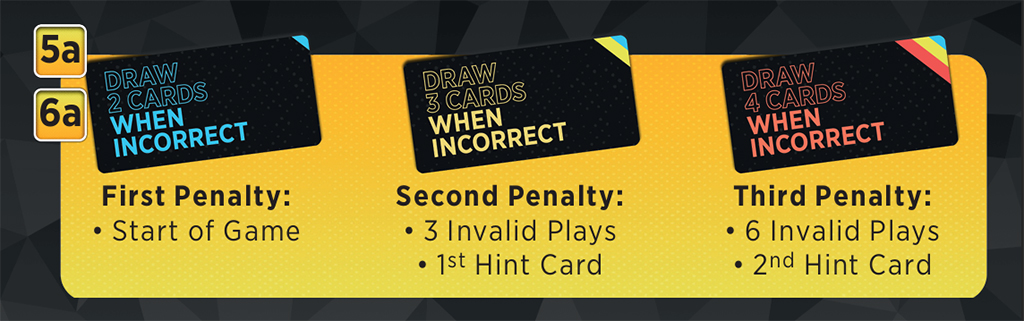
Mistakes require drawing more cards from the deck or market. The starting penalty is two cards, increasing to three when three invalid cards have accumulated along the line and four when there are six. Those extra cards make emptying your hand harder while using up the supply everyone depends on. A wrong answer provides information, but that information has a cost.
At the end of a round, the All Knowing reveals an Event Card. Hints also become available once the second penalty is active but using them costs cards from the draw deck. It’s another decision for the group: keep testing your explanation or spend some of that remaining supply for help.
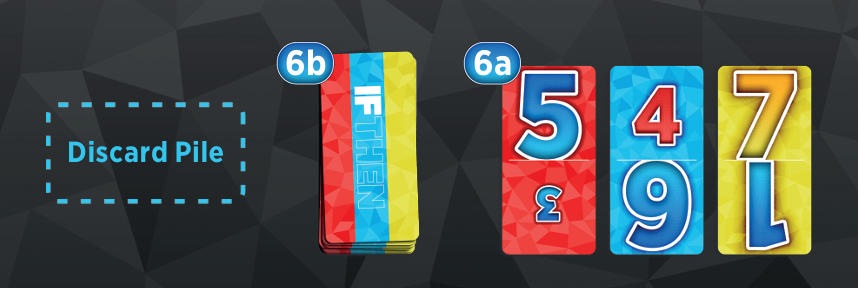
Everyone wins when all Code Breakers empty their hands. There’s also an opportunity to win by correctly guessing the challenge once only one Code Breaker has cards remaining. The group loses if a required draw cannot be completed from the available supply. Players who have emptied their hands can still help with the discussion, so finishing early doesn’t mean sitting out the puzzle.
The box includes four introductory challenges and forty each at Levels 1, 2 and 3. That gives you room to move toward more complex rules once the group understands the process. Start with the basics and let the challenge come from figuring out the pattern.
If you enjoy comparing clues and testing explanations, take a look at If/Then through your local game store or the Arcane Wonders website, where it lists for $19.99. Just remember that an incorrect guess can still teach you something. Preferably before you’ve drawn another handful of cards!
Did you enjoy code-breaking games like Mastermind growing up, or do you prefer a different kind of puzzle?